Nail Art in 2026: Which Techniques Last, Which Wreck the Nail, and What UV Lamps Actually Do
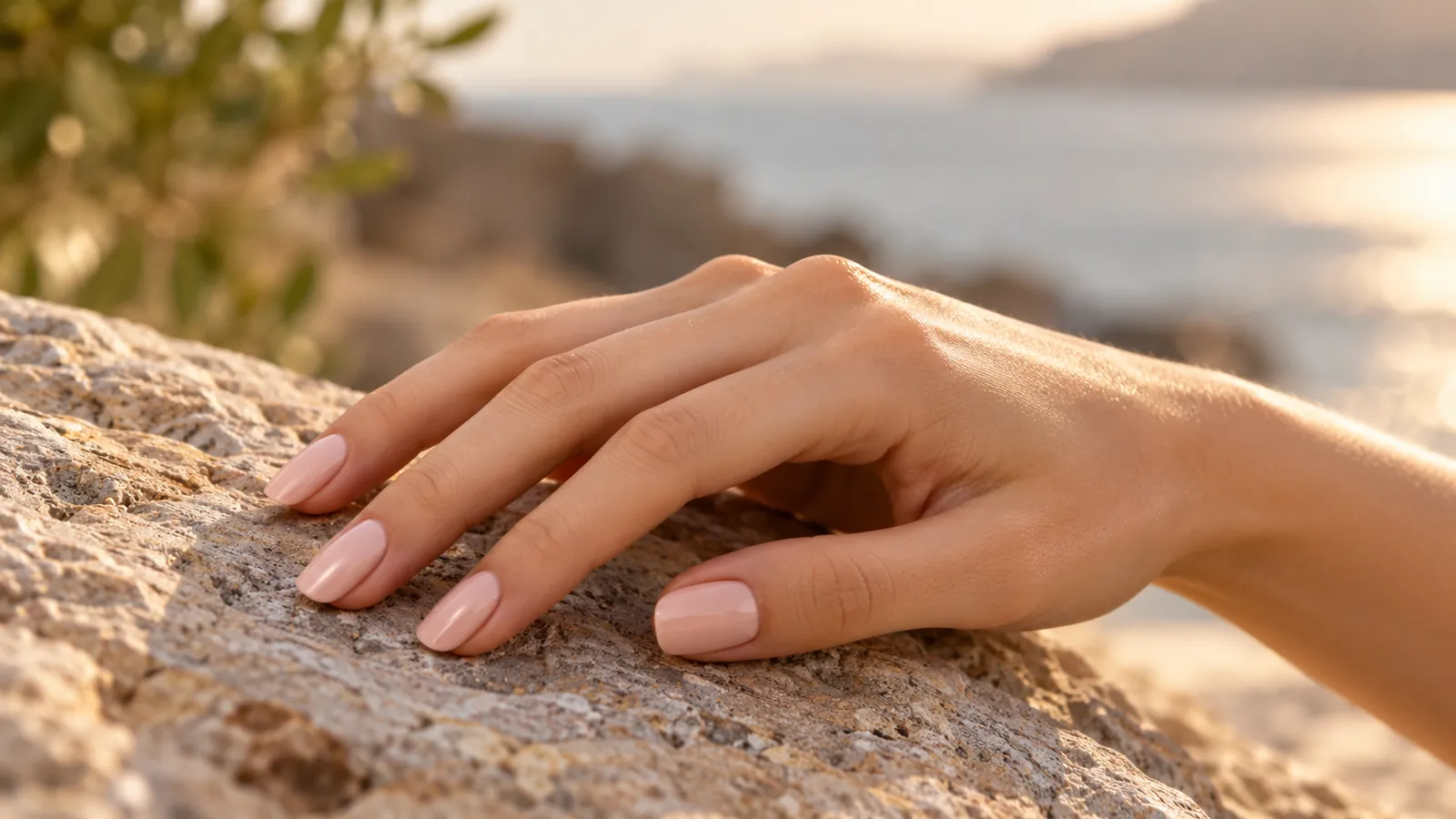
Everyone searching for next year's nail designs is asking the same two questions underneath: will it last, and will my nails be ruined afterwards. The answers are more settled than the internet suggests, and most of them are about removal rather than application.
This is a guide to the four systems you can book, what each asks of your nails, and what is established about the lamps. Nothing here is health advice: where a question is medical we say so and point you at the people qualified to answer it.
Gel, acrylic, builder gel, polish: four different materials
They get lumped together as "false nails". They are chemically and practically distinct.
- Regular polish. Pigment and resin in solvent. It dries as the solvent evaporates, with no lamp, and is the only one of the four you can remove at home with cotton wool.
- Gel polish (the soak-off kind). Brushed on like polish but cured by a lamp into a hard film: it does not dry, it polymerises. Designed to be dissolved later with acetone, once the top layer has been buffed open.
- Builder gel, including the in-a-bottle versions. A thicker lamp-cured gel adding strength and a little length. Soak-off versions exist; harder sculpting gels must be filed off.
- Acrylic. Liquid monomer mixed with powder polymer, hardening in air with no lamp. The strongest of the four and the usual choice for real length. It dissolves in acetone, so soak-off removal is standard.
Two more come up constantly. Dip powder bonds layers of powder with a resin adhesive and soaks off like gel polish. Press-ons and soft-gel tips are pre-formed nails fixed with adhesive or a gel overlay — the only category you can do at the kitchen table.
The useful distinction is not gel versus acrylic but soak-off versus file-off: anything filed off involves a tool near your natural nail, and that is where the risk lives.
How long each one lasts, and what the lifespan depends on
Typical figures, as technicians report them and most people experience them:
- Regular polish — a few days before chipping, less if your hands are often in water.
- Gel polish — two to three weeks without chipping, which is the whole reason it took over.
- Builder gel — three to four weeks, then an infill rather than a full removal.
- Acrylic — similar wear, with infills every two to three weeks as the nail grows.
- Press-ons — a day to two weeks, depending on adhesive and fit.
What ends a manicure is rarely the coating failing. Fingernails grow a few millimetres a month, so after a fortnight there is new nail at the cuticle and the set has migrated forward. The rest is mechanical:
- Preparation. Oil or residue left on the plate is the commonest cause of early lifting, and prep is the step home users skip.
- Length and shape. Long nails act as levers: the longer and squarer the free edge, the more force reaches the point where product meets nail.
- What you do with your hands — washing up without gloves, gardening, using a nail as a tool. Sanitiser and cleaning products shorten any coating's life.
- Coverage at the edges. Product flooding the cuticle lifts; product stopping short of the sidewalls peels. Neither is your fault, and both show within a week.
Removal is where nails get damaged
The coating does not eat your nail; the way it comes off can take part of the nail with it. The plate is a stack of thin keratin layers, and anything that peels or shears can take whole layers away — which is what produces the thin, bendy, white-patched nails people blame on gel in general. Two mechanisms do nearly all of it.
Peeling and picking. When a cured gel film lifts at one edge and you pull it, the bond between product and nail is often stronger than the bond between the nail's own layers, so the gel comes off with a layer of nail attached. The fastest way to damage a nail, and entirely avoidable.
Over-filing. An electric file is a legitimate professional tool, used to break the top coat's seal so solvent can get in. The problem is depth: a file that goes through the product into the plate thins the nail, and a thinner plate is more flexible, more prone to splitting and slower to recover. You can usually feel it as heat or sensitivity — the signal to speak up at the time.
What a careful soak-off looks like:
- The shiny top layer is buffed back only until it goes matte, not further.
- Pure acetone is held against the nail with a wrap, foil or clip and given time — ten or fifteen minutes, not hurried. "Gentle" acetone-free removers mostly cannot shift gel at all.
- The softened product is then pushed off with a wooden stick, with no resistance. Anything that resists goes back under acetone instead of being scraped or levered.
So a salon offering a full soak-off plus a new set in forty-five minutes is cutting something. And if you remove gel yourself, buy wraps and pure acetone and set aside half an hour — impatience does far more damage than the product.
UV and LED lamps: what is known, and who to ask
Gel cures because light of a particular wavelength triggers a photoinitiator in the formula. Both lamp types emit in the ultraviolet A range; "LED" describes the light source, not a different kind of radiation. LED lamps cure faster, so exposures are shorter, and a full manicure involves several short cures per hand.
This has been an active area of research and regulatory attention for years, published findings have not all pointed the same way, and the honest summary is that it is contested rather than settled. We are a fashion magazine, not a source of medical guidance, so we will not tell you what the risk is. What we can tell you is where the answers come from and what has changed:
- Cosmetic products in Great Britain are regulated under the UK's own cosmetics regime, enforced through local authority Trading Standards with oversight from the national product safety regulator. Alignment with EU decisions is not automatic, so the current position has to be checked rather than assumed.
- Ingredient restrictions have moved recently. EU rules restricted certain gel monomers to professional-only use after a wave of allergic reactions linked to home kits, and a widely used photoinitiator was later restricted on hazard-classification grounds. If your usual gel changed formula or disappeared, that is why.
- For anything about your own body — skin changes, pain, nails that are not recovering, a reaction after a manicure — a GP, dermatologist or pharmacist is the right person, not a salon and not an article.
- For practice standards — technician training, a sanitary setup, product storage — the UK beauty industry's professional associations and the sector's standards body publish guidance, and reputable salons say which accredits them.
On exposure: people who want to limit it ask for the LED lamp rather than the older UV box, keep hands under it only for the cure time, choose designs needing fewer layers, or wear fingerless gloves while curing. Any decent technician accommodates that. Whether you should is a question for a clinician.
Signs your nails want a break
These are cosmetic signs, the kind a technician notices — not a diagnosis. Anything painful, discoloured, lifting from the nail bed or changing shape belongs with a medical professional rather than a beauty appointment.
- The nail bends much more easily than it used to, and a new coating feels heavy on it.
- Dull white patches, often in the shape of previous filing — surface layers removed.
- Peeling in sheets from the free edge rather than snapping cleanly, or pits and grooves where a file ran.
- Coatings that now lift within days on nails that used to hold them for weeks.
- Any sensitivity during filing or curing, which is a reason to stop the appointment.
A break means letting the nail grow out with nothing structural on it. Plain polish does not interfere, if you want the colour.
Home kits against the salon: where the saving is real
Indicative UK prices, which vary a great deal by city:
- Salon gel polish manicure — commonly £25 to £45, higher in central London, with removal of an existing set often £10 to £20 or included with a new set.
- Builder gel or acrylic extensions — a full set usually from £40 to £70 and up, infills roughly £30 to £50 every two to three weeks.
- A home gel kit — a lamp at £15 to £40, plus base and top coat, colours at a few pounds each, prep wipes, a file, pure acetone and wraps.
- Press-ons — a few pounds a set, considerably more for custom work from an independent nail artist.
The saving is real for gel polish on short, unextended nails: most people can learn it, and the per-wear cost drops fast. It is largely illusory for extensions and anything needing an electric file, because the skill gap is the whole product and a bad set costs you the removal fee plus the recovery time. Press-ons are the genuinely cheap route to elaborate art — provided you soak them off instead of prising them off.
This season's looks, sorted by what they ask of your nails
The design is usually neutral; what matters is the structure underneath and the length it needs.
Easy on the nail: short natural-length sets; French tips and their variants, which grow out gracefully; chrome, pearl and cat-eye finishes, which are pigment and top coat rather than extra bulk; single-nail accents; anything on press-ons.
Middling: milky and sheer overlays, which tempt technicians into extra buffing; encapsulated glitter, which adds layers and so a longer soak-off; deep colours worn long, where picking a chip is the hazard.
Demanding: long sculpted extensions, where the free edge is a lever; heavy charms and gems, which add weight and catch on everything; very thin ultra-long shapes; hard gels that must be filed rather than soaked off; and anything involving a hole drilled through the plate for a piercing, which removes material from a structure that does not grow back quickly.
None of these is forbidden; they need a competent technician and a plan for removal. One rule covers nearly all of it: choose the shortest length the design can live at, and never take anything off in a hurry.
Sources
- UK cosmetics regulation and product safety guidance, as administered by the national product safety regulator and local authority Trading Standards
- EU cosmetics ingredient restrictions covering nail gel monomers and photoinitiators
- British Association of Beauty Therapy and Cosmetology
- Habia, the standards-setting body for the UK hair and beauty sector
- Published research on UV nail lamp exposure, which remains an area of active study and disagreement
- Salon price lists across several UK cities, and retail listings for home gel kits