Hand-Crochet or Machine-Made? How to Tell the Difference Before You Pay
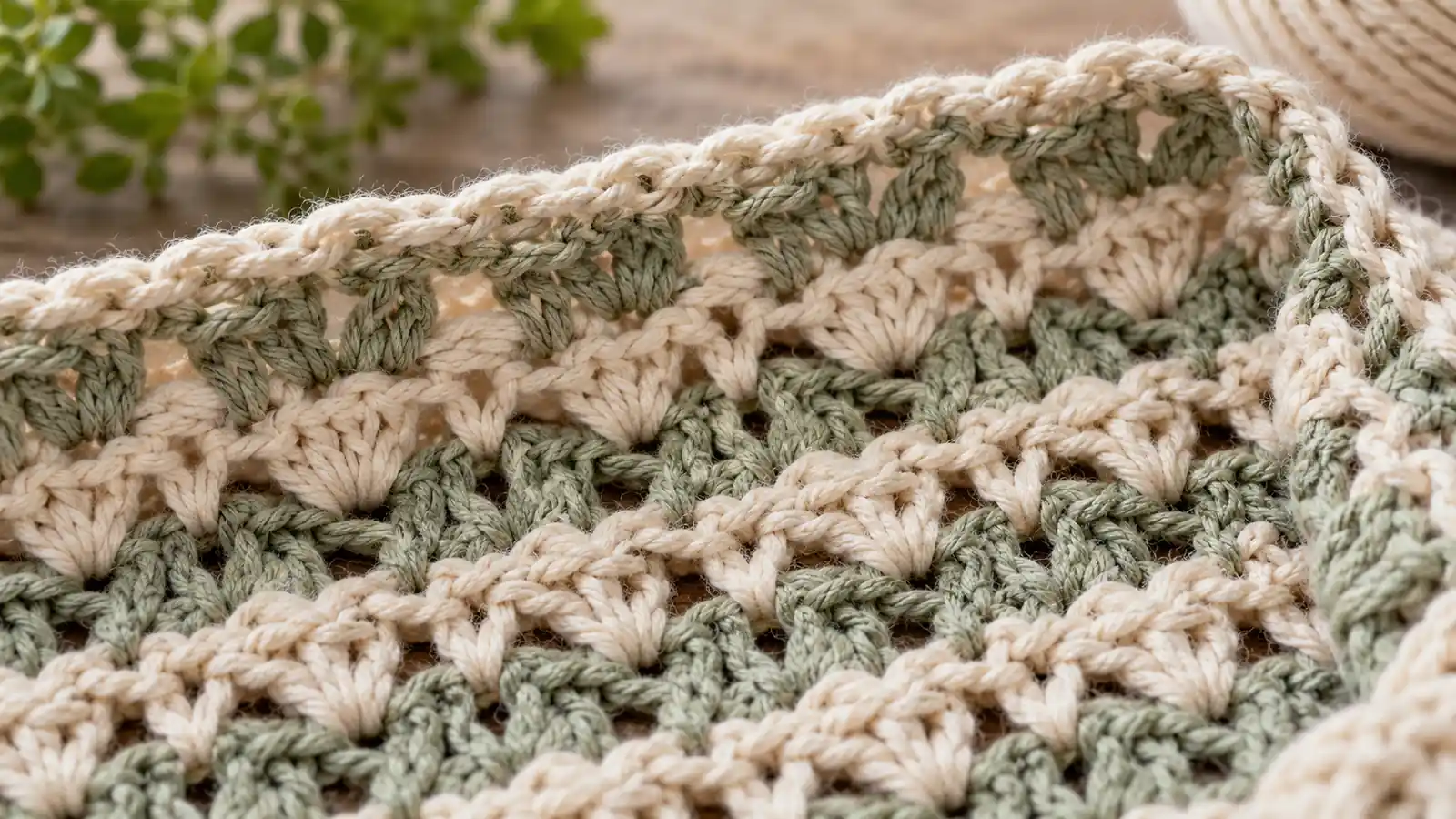
A crochet cardigan on the high street costs about the same as a takeaway for two. The one on an independent maker's stall costs as much as a weekend away. They can look near-identical on the hanger, and the difference is almost never printed on the label.
This is a guide to telling them apart with your hands and eyes, in the shop, before you pay. It covers what the word "crochet" actually means on a mass-market swing tag, the five checks that give the game away, what you are buying when you buy hours of someone's time, and how to keep the thing from growing a size every time you wash it.
Why crochet cannot be fully automated
Knitting and crochet are not two styles of the same process. A knitting machine holds a whole row of live loops on a bed of needles and works them at once, which is why industrial knitting scales so beautifully. Crochet holds one live loop at a time, and the hook travels into, around and sometimes behind the fabric to place the next stitch. That freedom is what makes crochet good at lace, motifs and three-dimensional edges, and it is what has defeated every attempt to mechanise it.
One caveat trips people up. The industry does have machines called crochet machines, or crochet galloon machines, and they are widely used — but what they make is narrow fabric: tapes, braids, elastics, trims. Technically they are warp-knitting machines, and they do not produce a garment body in true crochet stitches. So if a factory garment looks crocheted, it is almost always one of these instead:
- An open knit that mimics the look — a pointelle, laddered or mesh knit with holes arranged in a crochet-ish grid.
- Machine-made lace, cut and sewn — flat lace fabric cut into pattern pieces and overlocked together.
- A jacquard or printed imitation — texture that is woven or printed in rather than built from stitches.
- Genuine hand-crochet made as piecework — real crochet, made by hand, usually by outworkers paid per piece and assembled in a factory. This is common in cheaper "real" crochet, and it is the category where it is worth asking who made it.
So "crochet" on a mass-market tag describes a look, not a method. The words that mean something are "hand-crocheted" and "handmade" — and even those are not legally defined.
Five checks on the garment itself
Do these in order; the first two settle most cases.
1. Turn it inside out
Hand crochet looks structured on the reverse, with the same chunky, knotted-looking stitch bodies as the front, just oriented differently. Machine-made open knits usually give you a giveaway: long floats of yarn running across the back of the holes, a smooth jersey-like ground behind the pattern, or visible ladders where stitches have been deliberately dropped. If the back looks like a different fabric from the front, it is machine knitting.
2. Find the joins between motifs
Granny squares, hexagons, flowers and shells have to be joined somehow. In hand work you will see a deliberate seam: a ridge of slip stitches, a row of single crochet worked through both edges, or whip-stitching in matching yarn. The seam is part of the design and it follows the motif edges. In an imitation, either there are no joins at all because the motifs are knitted continuously, or the joins are overlocked machine seams that cut straight across the pattern without respecting it.
3. Look at which way the stitches lean
Machine knitting produces vertical columns of identical loops, all facing the same way, like the inside of a sock. Hand crochet worked in rows reverses direction every row, so adjacent rows lean slightly against each other and you can often count the ridges. Worked in the round, it spirals outwards from a centre point, and you can usually find that centre on a motif.
4. Measure the repeat
Take two motifs from opposite ends of the garment and compare them. Machine output is identical to a fraction of a millimetre. Hand work drifts: one square is marginally bigger, one flower has slightly tighter petals, the tension changes where the maker got tired. Small irregularity is the single most reliable sign of hand work, and it is also the thing people wrongly treat as a fault.
5. Hunt for yarn ends
Every hand-crocheted motif starts and ends with a tail that someone has to weave in. Look on the inside, at seams and motif centres: you will find short darned-in ends, sometimes a small knot. Machine fabric is cut from a length and the raw edges are overlocked or bound, so there are no woven-in ends anywhere, only cut edges and chain-stitched seams.
One bonus test by feel: genuine crochet is relatively stiff and inelastic for its weight. It has give because of the holes, but it does not snap back the way a rib-knit does. A springy "crochet" jumper is a knit.
What you are paying for in a handmade piece
In descending order of cost: hours, yarn, overheads.
Hours dominate. A plain beanie is an evening; a bucket hat or bralette is a weekend. A motif cardigan is commonly described by makers in tens of hours, because every square is made, counted, blocked and joined individually. Run that against anything close to a legal UK wage and you can see why a genuinely hand-crocheted cardigan cannot land in two figures without someone being paid very little.
Yarn is the second line. An adult cardigan typically needs several hundred grams, and yarn is sold in 50g or 100g balls, so you are buying multiple balls before a stitch is made. Natural fibres cost several times what acrylic costs, and British-spun wool from a named flock costs more again. If a piece is £40 and claims to be merino, the arithmetic does not work.
Overheads are the invisible part: pattern development, sampling the thing twice before it works, stall fees, packaging, postage, platform commission, photography and listing. Independent makers routinely say they have underpriced their work, and this is usually where it happened.
What the label tells you, and what it does not
In the UK, fibre composition labelling is a legal requirement: a textile garment must declare what it is made of, by percentage, using the recognised fibre names. Care instructions are not mandated in the same way, which is why some independent makers include a printed care card instead of a sewn-in label.
So the composition is the trustworthy part of the tag. Read it first:
- 100% cotton — the classic crochet fibre. Heavy when wet, holds stitch definition, grows under its own weight.
- 100% acrylic — cheap, light, warm enough, pills, and does not reblock once it has stretched.
- Wool, merino, alpaca, mohair — more expensive, can be reshaped when wet, needs gentler washing.
- Viscose, polyester and polyamide blends — very common in machine "crochet-look" fabrics. Not disqualifying on its own, but combined with a smooth reverse side it is a strong hint.
Phrases that should slow you down: "crochet-effect", "crochet-style", "lace knit" and "broderie" all describe appearance. "Hand-finished" usually means a machine made the fabric and a person did the seams. "Hand-loomed" means a hand-operated knitting machine — skilled work, but not crochet. Only "hand-crocheted" claims the method, and since the term is unregulated, treat it as a claim to verify rather than a guarantee.
If you are buying from an independent seller, ask who made it and how long it took. People who crocheted it themselves answer instantly and in detail. Resellers do not.
Rough price bands in pounds
These are indicative UK bands rather than fixed figures, and they move with yarn prices and the season. Use them to spot things that are suspiciously cheap for what they claim to be.
- High-street crochet-look knit — roughly £25–£60 for a cardigan or top. Machine-knitted, synthetic or cotton blend, identical repeats.
- Mass-market genuine hand-crochet, made as piecework — roughly £50–£120. Real crochet, real irregularity, no information about who made it.
- Small items from an independent UK maker — roughly £30–£90 for a hat, bralette, bag or blanket square set.
- A cardigan or jumper from an independent UK maker — from around £150, and often well past £300 depending on yarn and motif density.
- Designer pieces and brand collaborations — several hundred upwards, where part of the price is the name and the rest may or may not be hand work. Apply the checks regardless of the price tag.
Care: why crochet grows, and how to fix it
Crochet fabric is mostly air held in place by stitches with very little elastic recovery. Add water, and the fibre gets heavy; hang it up wet, and gravity does the rest. That is the entire mechanism behind "it was fine until I washed it".
What works:
- Measure before you wash. Note length, chest and sleeve with a tape. You cannot reshape to the right size if you do not know what it was.
- Wash cool and gently — by hand with a wool-safe or non-biological detergent, or a cool delicates cycle inside a mesh bag. Squeeze, do not wring.
- Get the water out without stretching. Press between two towels, or use a very short, slow spin. Never lift a sopping crochet garment by the shoulders.
- Dry flat and reshape on a towel, pushed back to your recorded measurements, until completely dry. Wool and cotton set to whatever shape they dried in, which is the point.
- Store folded. Hanging is what turns a cardigan into a coat over a couple of years.
Wool and cotton can be reblocked repeatedly, so a stretched piece is recoverable. Acrylic is the exception: once stretched hard or pressed with heat, the fibre takes a set and will not come back.
Where to find the real thing
Independent makers remain the most reliable source, and in the UK they are easy to meet in person. Craft fairs and makers' markets run year-round, and the larger textile and craft shows have whole halls of yarn and finished work — also the best place to handle good crochet and calibrate your eye for free. Local yarn shops often know makers who take commissions.
Online, look for sellers who show work in progress, name their yarn, quote their own measurements rather than generic sizes, and talk about turnaround in weeks. For resale, search motif names — granny square, pineapple, filet, shell — rather than brands: they turn up hand work the seller never recognised as such. Charity shops are slower and cheaper, and the five checks work just as well on a rail of donations.
Buy the irregular one. It is the one a person made.
Sources
- The Knitting & Crochet Guild
- Crafts Council
- UK textile labelling and fibre composition regulations
- Textile Services Association, on garment care and washing
- High-street retailers' own product descriptions and price lists, compared with independent makers' listings